The Worland Family in America and Beyond

I began my life in the Puget Sound area of Washington State, on an island filled with forests and wild rhododendrons. I was separated from my Worland family there at an early age. Recently, I was reunited with my family and learned of my heritage. And so, this journey to know my ancestors began. The Worlands, Gideons, Newtons, Conards... they were the colonists, the settlers, the pioneers. They fought in the American Revolution, the War of 1812, the Civil War. This is their story, and the story of a nation. -Deci Worland MacKinnon

Showing posts with label Middletown Connecticut. Show all posts

Thursday, February 27, 2014

March 1743, Connecticut

Union Street, Middletown, Conn, by Bundy, J.K....
Union Street, Middletown, Conn, by Bundy, J.K. (Joseph K.) (Photo credit: Wikipedia)

March 17, 1743- A daughter, Abigail, is born to Nathaniel Doolittle & Hannah Foster in Middletown, Middlesex, Connecticut.

March 25, 1743- A son, Seth, is born to Joseph Blake & Esther Bacon in Middletown, Middlesex, Connecticut.

 (Abigail Doolittle is my first cousin 8 times removed. Our common ancestors are Samuel Doolittle & Mary Cornwall.
Seth Blake is my second cousin 8 times removed. Our common ancestors are Nathan Bacon & Ann Miller and Deacon Thomas Whitmore.)
Enhanced by Zemanta

Thursday, February 20, 2014

January 1743, Connecticut

Black Rock Fort at Fort Nathan Hale historic s...
Black Rock Fort at Fort Nathan Hale historic site, New Haven, CT. (Photo credit: Wikipedia)

January 25, 1743- A son, Jonathan, is born to David Dutton & Sarah Abernathy in Wallingford, New Haven, Connecticut.

January 31, 1743- Elizabeth Whitmore, widow of William Savage, dies at the age of 59 in Middletown, Middlesex County, Connecticut.
Elizabeth was the daughter of Lieutenant Francis Whitmore & Hannah Harris. At age 20, she marriedDaniel Clark. They were wed 22 years, and Daniel ran a copper shop. Following his death in 1725, she then married William Savage, who died a few months later.

(Jonathan Dutton is my third cousin 7 times removed. Our common ancestor is Abraham Doolittle.
Elizabeth Whitmore is my second cousin 9 times removed. Our common ancestor is John Whitmore.)
Enhanced by Zemanta

Tuesday, December 3, 2013

December 1742, Connecticut


File:Israel putnam birthplace.jpg
Israel Putnam birthplace
 
December 1742- The last wolf in Connecticut was killed. The story goes that Israel Putnam, who later became a hero of the Revolutionary War, led an effort, with the help of a group of farmers from Mortlake, to find and kill a marauding wolf that was savaging sheep flocks in the northeast part of the state.
The den where the wolf was found and cornered is in Mashamoquet Brook State Park. On the right of the den, is a plaque that reads, in part:
''Following her tracks through one day and night in the early snow of December 1742 to the Connecticut River and back, the early settlers of this region here discovered the den of the she wolf that had for years devastated their flocks.'' Putnam, then in his early 20's, was the only one willing to go in after the wolf.
''Israel Putnam, 70 of whose sheep had been slaughtered, at 10 o'clock at night, with a rope tied to his feet, first with a torch, again with a musket, entered this cave, and by the light of her angry eyes, shot and killed the marauder, and entering a third time, dragged forth the body of the last wolf in Connecticut.'' He emerged, according to one account, dragging the wolf by the ears to the acclaim of his companions.
The farmers thought killing all the wolves was necessary to safeguard their sheep and early settlements typically offered bounties on such predators.

December 9, 1742- Thomas Langton, son of Joseph Lankton & Rachael Cowles, marries Abigail Richards, daughter of Thomas Richards & Abigail Turner, in Farmington, Connecticut.

December 18, 1742- Samuel, son of Nathaniel Bacon & Esther Hubbard, dies at age 9 in Middletown, Middlesex County, Connecticut.

December 24, 1742- Christiana, daughter of Ebenezer Savage Wetmore & Elizabeth Cornwall, dies at the age of 7 in Middletown, Middlesex County, Connecticut.

(Samuel Bacon is my first cousin 8 times removed. Our common ancestors are Nathaniel Hubbard & Mary Earle and Nathaniel Bacon & Ann Miller and Deacon Thomas Wetmore.
Samuel Bacon and Christiana Wetmore are second cousins. Christiana Wetmore is my second cousin 8 times removed. Our common ancestors are Deacon Thomas Wetmore & Sarah Hall and William Cornwall & Mary Bailey.
Abigail Richards is my second cousin 8 times removed. Our common ancestors are Edward Turner & Mary Sanford.)


Enhanced by Zemanta

Monday, November 25, 2013

October 1742, Connecticut

October 13, 1742- Nathaniel Bacon III, son of Nathaniel Bacon & Hannah Wetmore, marries Amy Sage Harrison, widow of Edmund Harrison, in Middletown, Middlesex, Connecticut.

October 14, 1742- A son, Oliver, is born to Daniel Doolittle & Elizabeth Dayton in New Haven, New Haven, Connecticut.

Official seal of Middletown, Connecticut
Official seal of Middletown, Connecticut (


(Nathaniel Bacon is my first cousin 9 times removed. Our common ancestors are Nathaniel Bacon & Ann Miller and Deacon Thomas Wetmore.
Oliver Doolittle is my second cousin 9 times removed. Our common ancestors are Abraham Doolittle & Abigail Moss and John Cornwall & Martha Peck.)

MIDDLETOWN

Before Europeans arrived, the territory where Middletown now sits was held by the Wangunks on the east bank and the Mattabesetts on the west bank of the Connecticut River. These two peoples shared a common chief, Sowheag, at the time of the initial European settlement in 1650.
In 1650, the first English families arrived from Hartford, Wethersfield, and Windsor. The new community became officially a town the following year, adopting the name "Middletown" in 1653, a reference to its distance halfway between the mouth of the Connecticut River and Windsor.
The first Africans were brought from Barbados to Middletown as slaves eight years later in 1661. Slavery remained a part of Middletown life throughout the seventeenth and eighteenth centuries; by 1756, 218 slaves -- at the time the third largest African population in the colony-- lived among a population of approximately 5,44 Europeans.
Middletown and other Connecticut towns had their own militias, or train bands, and held regular training days. Colonial statute required Middletown to have a force consisting of at least eight armed men and a sergeant acting as guard at any assembly for public worship. The militia kept watch around the meeting house, a structure 20 feet square enclosed by a palisade.
During the fifty years before the guns of Lexington, Middletown merchants developed an extensive trade between New England and the West Indies. Middletown enjoyed booming times while the trade lasted. So closely was Middletown's economic life tied to the sea that, by the outbreak of the Revolution, one third of the population was engaged in maritime trade and merchant activities.
_The Society of Colonial Wars
Enhanced by Zemanta

Saturday, November 16, 2013

August 1742, Connecticut

South Main Street Looking North, Middletown, C...
South Main Street Looking North, Middletown, Connecticut
August 2, 1742- A daughter, Mary, is born to Jacob Whitmore & Rebecca Hurlbut in Middletown, Connecticut.

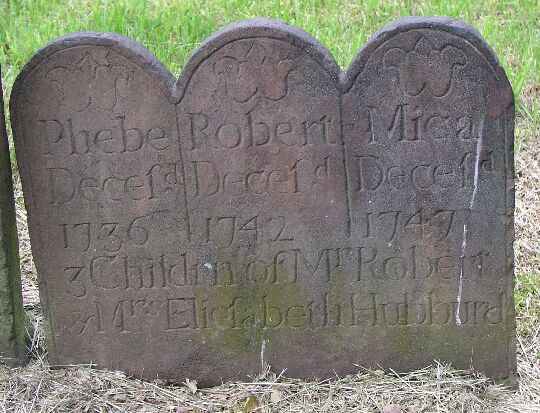
August 8, 1742- Robert, infant son of Robert Hubbard & Elizabeth Sill, dies in Middletown, Middlesex, Connecticut. He is five months old. He is buried in Mcdonough Cemetery.


Gravestone of Hubbard children.
(Robert Hubbard is my third cousin 7 times removed. Our common ancestors are George Hubbard & Elizabeth Watts and Thomas Wetmore & Sarah Hall. Marty Whitmore is his fourth cousin.
Mary Whitmore is my third cousin 8 times removed. Our common ancestors are John Whitmore and William Cornell & Mary Bailey.)


Religious affairs formed one of the most important problems in the life of Connecticut. The established ecclesiastical system was the Congregational. The Code of 1650 (Connecticut) taxed all persons for its support, provided for the collection of church taxes, if necessary, by civil distraint, and forbade the formation of new churches without the consent of the general court. The New England Half Way Covenant of 1657, which extended church membership so as to include all baptized persons, was sanctioned by the general court in 1664.
 The custom by which neighbouring churches sought mutual aid and advice, prepared the way for the Presbyterian system of church government, which was established by an ecclesiastical assembly held at Saybrook in 1708, the church constitution there framed being known as the “Saybrook Platform.” At that time, however, a liberal policy towards dissent was adopted, the general court granting permission for churches “soberly to differ or dissent” from the establishment. Hence a large number of new churches soon sprang into being. In 1727 the Church of England was permitted to organize in the colony, and in 1729 a similar privilege was granted to the Baptists and Quakers.
 A religious revival swept the colony in 1741. The very existence of the establishment seemed threatened; consequently in 1742 the general court forbade any ordained minister to enter another parish than his own without an invitation, and decided that only those were legal ministers who were recognized as such by the general court. Throughout the remaining years of the 18th century there was constant friction between the establishment and the nonconforming churches. 1911 Encyclopædia Britannica
Enhanced by Zemanta

Tuesday, November 12, 2013

July 1742, Connecticut

English: This an image of The Middletown Alms ...
 This an image of The Middletown Alms House in Middletown CT USA. (Photo credit: Wikipedia)
July 9, 1742- Jacob Cornwall dies at the age of 69 in Middletown, Middlesex, Connecticut.
The son of William Cornwall & Mary Bull, he was lame, and in 1724 was excused from the poll tax on that account.

(Jacob Cornwall is my first cousin 10 times removed. Our common ancestors are William Cornwall & Mary Bailey.)

In the early years, the American colonies would not admit people with disabilities because they believed such individuals would require financial support. Colonists enacted settlement laws whose restrictions included people with disabilities. People with disabilities who did not have the physical stamina to withstand the conditions of the day and were dependent on others were oftentimes forced to return to England. People who were part of the community received local aid; strangers were encouraged to move on.
As colonial towns increased in size, almshouses for the poor, elderly and people with disabilities were built. Parish officials were given the authority to raise taxes as needed and use the funds to build and manage almshouses; or to supply food and sustenance in their own homes for the aged and the handicapped. Almhouses became a refuge for the sick, the severely disabled, frail elderly and homeless children who were unable to work and had no one to care for them. Complicating the use of a poorhouse for the care of all destitute persons was the necessary mixing of the worthy and the unworthy poor. Often living in the same congregate setting were able-bodied adults as well as dependent persons such as children, the aged, the sick and the disabled. Eventually, separate facilities were established to care for the different populations, with the able-bodied being placed in a “workhouse” or “poor farm.”
Another popular means for caring for the handicapped and poor in early American communities using public funds was the contract system, auction of the poor, or “outdoor relief.” The contract system placed dependent persons under the care of a homeowner or farmer who offered to care for them for a lump sum. The process of “auctioning” the destitute resulted in an individual or family being placed with a local couple or family bidding the lowest amount of public funding needed to care for them.
Enhanced by Zemanta

Thursday, November 7, 2013

May 1742, Connecticut

1742map.jpg

May 2, 1742- Timothy Clark is born to Joseph Clark & Miriam Cornwell in Middletown, Middlesex County, Connecticut.

May 4, 1742- A son, Hezekiah, is born to Hezekiah Doolittle & Hephzibah Tyler in Wallingford, New Haven County, Connecticut.

May 5, 1742- Eunice Moss is born to Joseph Moss & Lydia Jones in Wallingford, New Haven County, Connecticut.

(Timothy Clark is my second cousin 8 times removed. Our common ancestors are John Cornwall & Martha Peck.
 Hezekiah Doolittle  is my third cousin 7 times removed. Our common ancestor is Abraham Doolittle.
Eunice Moss is my third cousin 8 times removed. Our common ancestors are John Moss & Abigail "Goody" Charles.)

Connecticut takes its name from an Algonquian word meaning “land on the long tidal river.” “Nutmeg State,” “Constitution State” and “Land of Steady Habits” are all nicknames that have been applied to Connecticut.
Enhanced by Zemanta