The Worland Family in America and Beyond

I began my life in the Puget Sound area of Washington State, on an island filled with forests and wild rhododendrons. I was separated from my Worland family there at an early age. Recently, I was reunited with my family and learned of my heritage. And so, this journey to know my ancestors began. The Worlands, Gideons, Newtons, Conards... they were the colonists, the settlers, the pioneers. They fought in the American Revolution, the War of 1812, the Civil War. This is their story, and the story of a nation. -Deci Worland MacKinnon

Showing posts with label Colonial Life. Show all posts

Saturday, November 30, 2013

November 1742, Massachusetts

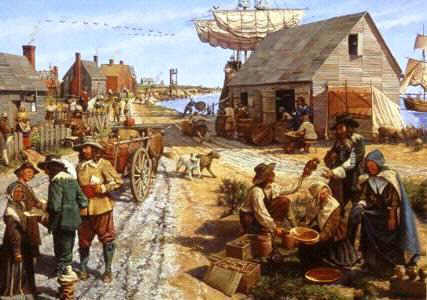
Servants and Colonists in Colonial America
  

November 15, 1742-A son, Tisdale, is born to Salisbury Sherman & Abigail Tisdale in Dartmouth, Bristol, Massachusetts.

(Tisdale Sherman is my third cousin 8 times removed. Our common ancestors are Thomas Lawton & Elizabeth Salisbury.)

 Life in New England

A majority of New England residents were small farmers. Within these small farm families, and English families as well, a man had complete power over the property and his wife. When married, an English woman lost her maiden name and personal identity, meaning she could not own property, file lawsuits, or participate in political life, even when widowed. The role of wives was to raise and nurture healthy children and support their husbands. Most women carried out these duties.
During the 18th century, couples usually married between the ages of 20-24 and 6-8 children were typical of a family, with three on average surviving to adulthood. Farm women provided most of the materials needed by the rest of the family by spinning yarn from wool and knitting sweaters and stockings, making candles and soap from ashes, and churning milk into butter.

New England farming families generally lived in wooden houses because of the abundance of trees. A typical New England farmhouse was one-and-a-half stories tall and had a strong frame (usually made of large square timbers) that was covered by wooden clapboard siding. A large chimney stood in the middle of the house that provided cooking facilities and warmth during the winter. One side of the ground floor contained a hall, a general-purpose room where the family worked and ate meals. Adjacent to the hall was the parlor, a room used to entertain guests that contained the family's best furnishings and the parent's bed. Children slept in a loft above, while the kitchen was either part of the hall or was located in a shed along the back of the house. Because colonial families were large, these small dwellings had much activity and there was little privacy.

By the mid-18th century in New England, shipbuilding was a staple, particularly as the North American wilderness offered a seemingly endless supply of timber (by comparison, Europe's forests had been depleted and most timber had to be purchased from Scandinavia) The British crown often turned to the cheap, yet strongly built American ships. There was a shipyard at the mouth of almost every river in New England.
By 1750, a variety of artisans, shopkeepers, and merchants provided services to the growing farming population. Blacksmiths, wheelwrights, and furniture makers set up shops in rural villages. There they built and repaired goods needed by farm families. Stores selling English manufactures such as cloth, iron utensils, and window glass as well as West Indian products like sugar and molasses were set up by traders. The storekeepers of these shops sold their imported goods in exchange for crops and other local products including roof shingles, potash, and barrel staves. These local goods were shipped to towns and cities all along the Atlantic Coast. Enterprising men set up stables and taverns along wagon roads to service this transportation system.
After these products had been delivered to port towns such as Boston and Salem in Massachusetts, New Haven in Connecticut, and Newport and Providence in Rhode Island, merchants then exported them to the West Indies where they were traded for molasses, sugar, gold coins, and bills of exchange (credit slips). They carried the West Indian products to New England factories where the raw sugar was turned into granulated sugar and the molasses distilled into rum. The gold and credit slips were sent to England where they were exchanged for manufactures, which were shipped back to the colonies and sold along with the sugar and rum to farmers.

Other New England merchants took advantage of the rich fishing areas along the Atlantic Coast and financed a large fishing fleet, transporting its catch of mackerel and cod to the West Indies and Europe. Some merchants exploited the vast amounts of timber along the coasts and rivers of northern New England. They funded sawmills that supplied cheap wood for houses and shipbuilding. Hundreds of New England shipwrights built oceangoing ships, which they sold to British and American merchants.

Many merchants became very wealthy by providing their goods to the agricultural population and ended up dominating the society of sea port cities. Unlike yeoman farmhouses, these merchants resembled the lifestyle of that of the upper class of England living in elegant 2 1⁄2-story houses designed the new Georgian style. These Georgian houses had a symmetrical façade with equal numbers of windows on both sides of the central door. The interior consisted of a passageway down the middle of the house with specialized rooms such as a library, dining room, formal parlor, and master bedroom off the sides. Unlike the multi-purpose space of the yeoman houses, each of these rooms served a separate purpose. In a Georgian house, men mainly used certain rooms, such as the library, while women mostly used the kitchen. These houses contained bedrooms on the second floor that provided privacy to parents and children. -Wikipedia
Enhanced by Zemanta

Monday, June 7, 2010

June 1720, Maryland


Sewing notions found during the archealogical excavation of St. Mary's City, Maryland. Implements such as these were likely used by Elizabeth Beard in her daily life.

June 1720- Elizabeth Beard, wife of James Meekin, has died in St. Mary's County, Maryland.

(Elizabeth Beard is my ninth great grandaunt. Our common ancestors are Alice & Robert Beard.)

Friday, November 20, 2009

Practices of the Quakers During the Colonial Period

A couple desiring to marry had to declare their intentions before a regular weekly Meeting of their local society. Appointed overseers would then conduct an investigation of the character of each. If nothing derogatory was found, the wedding was approved.

A check was kept by the local society with respect to the wedding date and the birth of the first child. A premature baby was examined by three women from three Meetings, often resulting in society records being annotated with an "F/B" meaning "relations before marriage and an illegitimate child, or "F/M" meaning the same, but that marriage had followed. Both situations must be condemned by the involved parties if they wished to remain with the society.

Persons who died were frequently returned to a former residence for burial. Some societies condemned headstones as a sign of vanity and often removed those already in place. Often burial places were left unmarked so that Indians would not know how many had died.

Meetings of the societies were held in the daytime and attendance was checked, carefully. First-day meetings were required attendance and midweek meetings were optional; but the member was judged on his spirituality by his attendance pattern.

A "certificate of clearance" was required to marry or to move into another local society. It would not be given if there were outstanding debts.

 Prior to 1753—and unofficially for some time afterward—they followed an unusual practice of numbering the months of the year. It was forbidden to refer to the usual names given for months such as January, February, etc., because those names were of pagan derivation. The numbering system began with March and so they would use, for instance, "1 mo. 25, 1703," meaning March 25, 1703.

 Their belief in non-violence, of course, precluded their serving in any military capacity and may explain why so few of the Potts Quakers served in the Revolutionary War.

Public acknowledgement was required for all sorts of misdeeds. This usually meant condemning their own actions by confession at a local Meeting. Meeting minutes were made of all known misdeeds, confessed
or not!

Saturday, October 17, 2009

Colonial Life- Childhood

In Colonial times, American childhood, as we know it today, did not exist. Children were important to their families, but were valued for their economic worth to their family and community. They were expected to take on adult responsibilities as soon as possible. At six years of age, boys were "breeched": their dresses and stays were removed and they put on adult clothes. Depending on their social status, they might have gotten their heads shaven and been fitted with powdered periwigs. Either way, from that point on, they were young adults and were expected to behave as such.

Childrearing varied somewhat from colony to colony. More women and children migrated to the New England colonies, and they were more able to maintain a strict family structure and patriarchal authority. They had large families and life expectancy was high.

In Maryland, a high percentage of immigrants were men who came over as indentured servants. They married later, and due to the malarial environment, life spans were short and the death rate was high. This often resulted in smaller families, sometimes of only two or three children. These children were greatly treasured, and there were less work responsibilies and less religious instruction. However, due to the reality of early parental death, many boys entered apprenticeship quite young or were left as heirs to manage properties and estates.

In Pennsylvania, the Quakers believed that children were born innocent. They had small families with strong emotional ties. They saw children as equals, and they were treated gently as they were guided to independence. This model greatly influenced childhood as we see it today.


As small children, both girls and boys wore dresses. This was partially related to toilet-training, as children did not wear underwear.  Around 16 months old, they began wearing "stays" (think of corsets) to help force correct posture, and girls would remain in them for the rest of their lives.
 

Between infancy and age eleven, chores included chopping wood, tending to livestock, gathering vegetables, picking worms off tobacco plants and dung out of fleece, hunting and butchering, prepping flax and thread for spinning, washing clothes in the iron kettle and working in the kitchen.

Boys learned early how to use guns for hunting and defense. They even served in military conflicts as "powder monkeys," carrying powder from magazines to guns on ships or in forts.

Since every member of a family or community was expected to contribute to the general welfare, formal education - for those fortunate enough to get it - focused on preparing children for life's practical needs. At the closest public school, boys were taught basic math and reading. They learned their ABCs through the use of a horn book, a thin piece of wood affixed to a sheet of paper on which was printed the alphabet; a transparent sheet of animal horn covered the paper. Some schools also taught penmanship, principles of religion, laws and good manners.

Girls were instructed at home. As early as age six, they began learning embroidery, which also served to teach letters and numbers. One would create a "sampler" piece, on which were stitched the alphabet, simple numbers, phrases and designs. After that, she practiced reading skills using whatever printed material was in the house but especially the Bible.

Upper class children had private tutors who taught them Latin, Greek, rhetoric, logic, geometry and dancing. Musical instruction usually included learning to play an instrument such as violin or harpsichord.

Even with all those responsibilities, children did make time for play. Some forms of recreation back then would be recognizable today in both name and content, such as ice skating, kite flying, jump rope, marbles and bobbing for apples. But some familiar activities had different names, and other games have since been transformed or totally died off. These include:

• Quoits - Wooden or rope circlets were thrown over a post, similar to horse shoes.

• Draughts - Another name for checkers.

• Hoop and Stick - Boys would run, driving a wooden hoop (two and a half feet across) with a nine-inch stick. Two girls would use their sticks to pass the hoop between them.

• Skittles - Also called ninepins. One ball was used to bowl over nine pins with the goal of bowling exactly 31 pins.

• Witch in a Bottle - Similar to Freeze Tag.

Fun and Games in Colonial America (Colonial America)


Usually beginning at fourteen, though often as young as seven, boys could be apprenticed to a master craftsman who would, over the next two to four years, teach him a trade. That could have been anything from shoemaking, metal working or weaving to paper working, glassblowing or surveying.

For girls, adulthood meant marriage and children of their own.

Sunday, October 11, 2009

Colonial Life- Childbirth and Infancy

Childbirth in colonial America was a difficult and sometimes dangerous experience for women. During the seventeenth and eighteenth centuries, death in childbirth was sufficiently common that many colonial women regarded pregnancy with dread. In their letters, women often referred to childbirth as "the Dreaded apperation," "the greatest of earthly miserys," or "that evel hour I loock forward to with dread."

Still, most births were welcome. The Christian religion taught that God would provide bountiful blessings through a loving union between husband and wife. It was the duty of a married couple to produce children, and the barren were looked down upon. A large family was also the surest method toward a successful business or farm.

Since the typical mother gave birth to between five and eight children, her lifetime chances of dying in childbirth ran as high as 1 in 8. This meant that if a woman had eight female friends, it was likely that one might die in childbirth.
In addition to her anxieties about pregnancy, an expectant mother was filled with apprehensions about the death of her newborn child. In the Colonial era, parents loved their children but still held them somewhat at a distance emotionally. After all, children weren't expected to live long. The infant mortality rate was between 25 and 50 percent. In the healthiest communities, one infant in ten died before the age of five. In less healthy environments, three children in ten died before their fifth birthday. If a child made it to the "magic age" of eleven, he or she had a good chance of living a long time.

Given the high risk of birth complications and infant death, it is not surprising to learn that pregnancy was surrounded by superstitions. It was widely believed that if a mother looked upon a "horrible spectre" or was startled by a loud noise her child would be disfigured. If a hare jumped in front of her, her child was in danger of suffering a harelip. There was also fear that if the mother looked at the moon, her child might become a lunatic or sleepwalker. A mother's ungratified longings, it was thought, could cause an abortion or leave a mark imprinted on her child's body. At the same time, however, women were expected to continue to perform work until the onset of labor, since hard work supposedly made for an easier labor. Pregnant women regularly spun thread, wove clothing on looms, performed heavy lifting and carrying, milked cows, and slaughtered and salted down meat.

In colonial America, the typical woman gave birth to her children at home, while female kin and neighbors clustered at her bedside to offer support and encouragement. Most women were assisted in childbirth not by an doctor but by a midwife. During labor, midwives administered no painkillers, except for alcohol. Pain in childbirth was considered God's punishment for Eve's sin of eating the forbidden fruit in the Garden of Eden. Women were merely advised to "arm themselves with patience" and prayer and to try, during labor, to restrain "those dreadful groans and cries which do so much discourage their friends and relations that are near them."

Most midwives were older women who relied on practical experience in delivering children. Skilled midwives were highly valued. Communities tried to attract experienced midwives by offering a salary or a house rent-free. In addition to assisting in childbirth, midwives helped deliver the offspring of animals, attended the baptisms and burials of infants, and testified in court in cases of bastardy.

For the first few months, infants were tightly bound  in swaddling linen from ankles to neck. Parents feared that without swaddling clothes, the child would not grow straight. The infant remained swaddled day and night. Infants slept with their parents, and extended crying was seen as beneficial, as it exercised their lungs.